The PoleOS™ Company



Understanding NESC clearance rules for guy wires
Requirements for installing or maintaining down guys and span guys
Proper placement and clearance of guy wires is essential for utility safety and code compliance. The National Electrical Safety Code (NESC) provides specific requirements for both down guys (anchor guys) and span guys, though these rules are often misunderstood or overlooked. This blog explores the key clearance requirements that utilities must follow when installing and maintaining these critical support structures.
A fundamental requirement: Grounding or insulation
Before diving into clearance requirements, it’s important to understand that all guys must meet one fundamental safety requirement: According to NESC Rule 215C2, they must be either grounded or insulated. This protects both the public and utility workers from hazardous voltage if a guy wire comes into contact with energized conductors.
Rural utilities and cooperatives typically use grounded guys as a standard practice, stemming from decades-old Rural Utilities Service (RUS) requirements. Investor-owned utilities more commonly use guy insulators. When insulators are used, they must be positioned so that if the guy breaks or becomes slack, they remain at least 8 feet above ground to protect the public.
Overhead clearance requirements for down guys
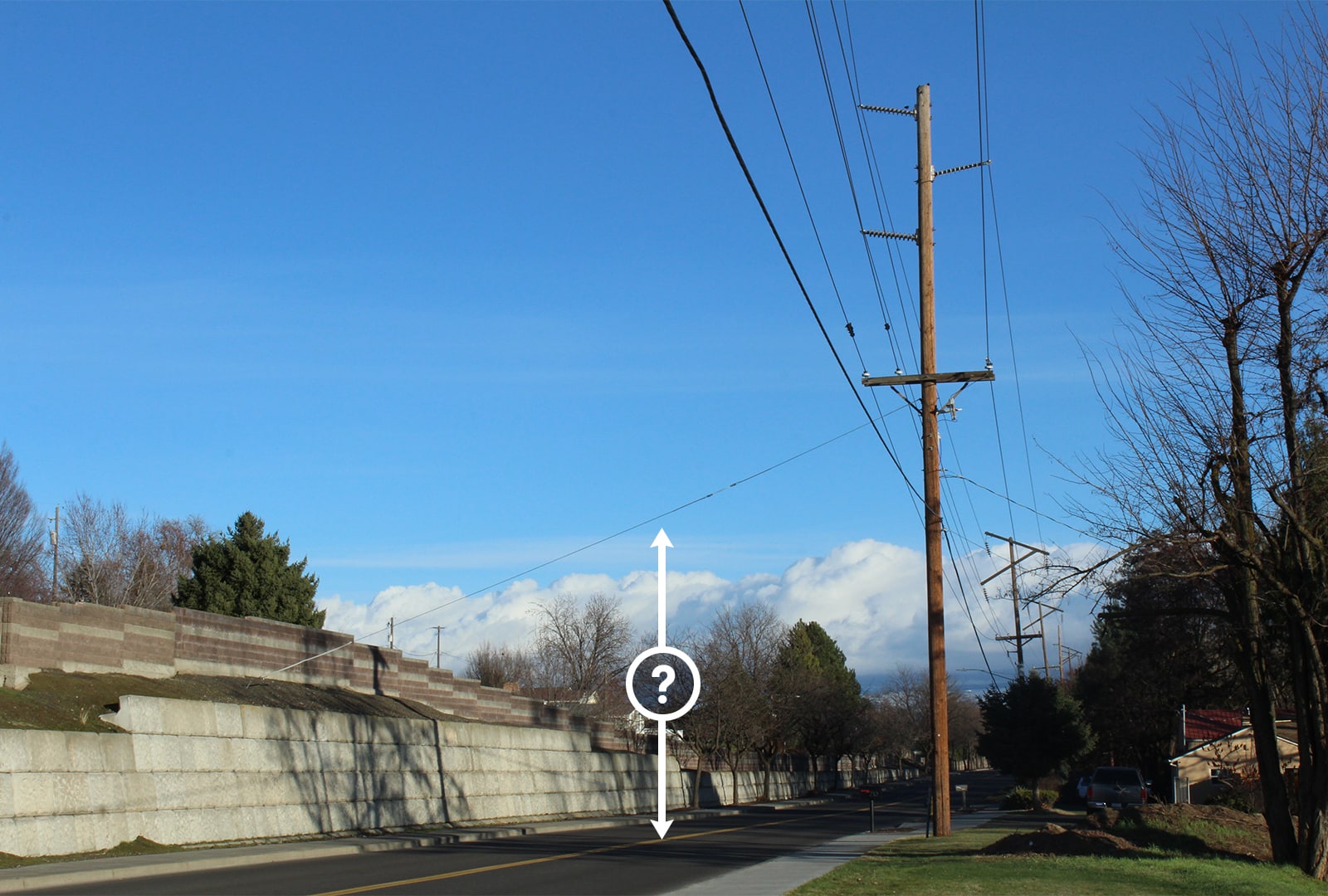
Down guys, also known as anchor guys, are addressed in Table 232-1 of the NESC, which covers clearance above ground. This is one of the most frequently referenced sections of the Code, and for good reason—it applies to numerous scenarios utilities encounter daily.
Key exception: Footnote 11
Footnote 11 provides an important exception: No clearance from ground is required for anchor guys unless they cross tracks, rails, streets, driveways, roads, or pathways. This means a standard down guy running from the pole to an anchor in open ground doesn’t require specific height clearance. However, if a guy crosses any area where vehicles or pedestrians pass beneath it, clearance requirements apply.
Vehicle clearance
When a down guy crosses over a roadway where vehicles travel beneath it, the standard clearance of 15.5 feet applies. This is the baseline clearance required anywhere trucks, farm equipment, or other large vehicles are expected. This clearance must be maintained even though it’s technically a guy wire rather than a power conductor.
Pedestrian clearance and sidewalk guys
For guys crossing pedestrian pathways—commonly called sidewalk guys or Queen’s Posts—different clearances apply. Table 232-1, Row 9, specifies that communication lines must maintain a 9.5-foot clearance over pedestrian areas, while braces and crossarms (found in Table 232-2) require a 9-foot clearance.
A sidewalk guy installation typically uses a horizontal strut or post to elevate the guy wire above pedestrian traffic. The strut itself must maintain the 9-foot clearance requirement, while the guy wire must meet the 9.5-foot clearance where applicable.
One important consideration often overlooked: If an area has mounted police patrols or other large animals, pedestrian clearances don’t apply. Higher clearances must be used to account for riders on horseback.
Guy markers
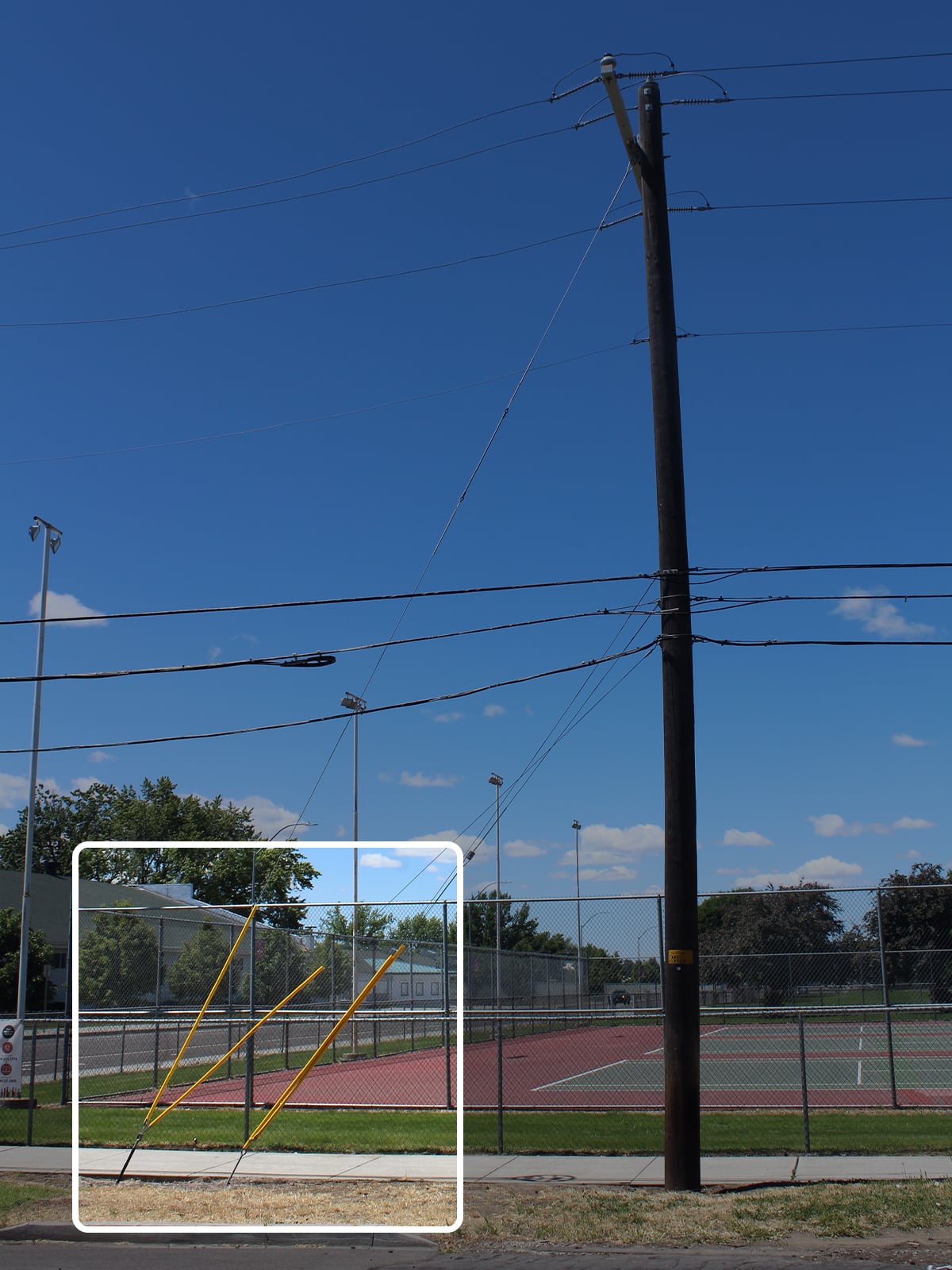
Rule 217C requires that guys exposed to pedestrian traffic must be marked or protected. The 2023 edition of the NESC clarified this requirement by adding the word “each,” making it explicit that every guy exposed to pedestrian traffic needs its own marker—even if multiple guys attach to the same anchor.
Guy markers serve as critical safety devices, helping prevent accidents with motorcycles, snowmobiles, or pedestrians who might not otherwise see the wire. While the Code uses somewhat vague language about what constitutes “sufficient distance” or being “exposed to pedestrian traffic,” best practice suggests marking guys liberally, especially in areas where any public access exists.
Joint-use considerations
Joint-use poles present additional complexity when it comes to guy wire clearances. While guys aren’t listed in Table 235-5 (the table that establishes the 40-inch communication worker safety zone), they do appear in Table 235-6.
Table 235-6 specifies that guy or span wires must maintain 6 inches of clearance from communication lines on joint-use poles. This measurement applies in any direction—vertical, horizontal, or diagonal—where the guy passes near communication cables.
Guy insulation and positioning
Footnote 1 of Table 235-6 contains a crucial safety requirement that has been the subject of fatal accidents: On joint-use poles, if a guy passes closer than 12 inches to both power supply conductors and communication cables, it must either be insulated where it passes the power, or a guy insulator must be positioned between the power and communication facilities.
This positioning ensures that if a guy wire contacts energized conductors, the portion of the guy passing near communication lines and equipment will not become energized. Multiple fatalities have occurred when this requirement wasn’t met, particularly involving jumpers or taps where guys passed close to both power and communication facilities.
Span guys: Unique clearance scenarios
Span guys (sometimes called overhead guys) present their own clearance challenges. These guys run from one pole to another, often with a down guy at the receiving pole. The span guy must maintain NESC-specified clearances above ground to allow vehicles and pedestrians to pass safely beneath.
When working with span guys:
- They must follow the same insulator positioning rules as down guys on joint-use structures.
- Vehicle clearances apply if crossing roadways (15.5 feet).
- The 6-inch clearance to communication lines applies where the guy attaches at the pole.
- No clearance is specified between two span guys attached to the same pole.
Important clarifications
Guy-to-guy clearances
The NESC does not specify any clearance requirement between guy wires. While utilities should use common sense to prevent guys from rubbing together and causing mechanical damage, crossing guy wires or guys attached to the same anchor plate does not constitute a Code violation.
Anchor spacing
Similarly, the NESC doesn’t mandate specific spacing between anchors. However, engineering principles dictate that anchors placed too close together share stress cones in the soil, reducing overall holding strength. Many utilities use 5- or 6-foot spacing as standard practice, but the Code only requires that anchors have sufficient strength to resist the applied loads.
Compliance responsibility
Rule 214 requires utilities (both power and communications) to inspect their lines and fix any violations discovered. While the Code doesn’t specify who pays for corrections or how they’re accomplished, the responsibility for ensuring compliance rests with the utility once they become aware of violations.
For new attachments to existing poles, the rule is straightforward: You cannot create a new violation or make an existing violation worse. If existing violations are present, they should be documented and reported to the pole owner during make-ready work, triggering the owner’s obligation to correct them.
Conclusion
Guy wire clearances involve multiple NESC sections and numerous special cases. Each scenario requires careful attention to applicable rules. By closely following these requirements and applying accepted good practice where the Code is less specific, utilities can ensure both compliance and public safety in their guy wire installations.
The complexities surrounding anchor and span guys are an example of why staying up to date on the NESC is so important for anyone working with overhead lines. IKE’s NESC training classes break down the Code and demonstrate how to apply requirements to real-life scenarios. We offer customizable group classes where you can train entire teams together, as well as classes for individuals on popular topics. I hope to see you at an upcoming class!
Know the Code. Stay safe.
Learn more about NESC and OSHA training classes with IKE
Grant Glaus is a registered professional electrical engineer with more than 27 years of experience in electric utility engineering, including line design, planning studies, joint use, and teaching NESC, OSHA, and distribution line design classes. He has served on IEEE NESC committees since 2006 and is currently a member of the NESC Main Committee and Subcommittee 5 Overhead Lines–Strength and Loading.

The latest from the IKE Wire
IKE Q3 2026 product updates
Over the last quarter, we added even more efficiencies to your field-to-finish workfl...
Read MoreNESC requirements for fiber-optic cables in the supply space
As a member of National Electrical Safety Code (NESC) committees and IKE’s NESC tra...
Read MoreHow to choose the right OSP data collection solution
Comparing five OSP field technologies and the common use cases they support When it c...
Read MoreSubscribe to the IKE Wire
Get the latest insights on data acquisition and structural analysis from the ikeGPS experts.