The PoleOS™ Company



Pole loading analysis: From engineering due diligence to core risk management
- Utilities

Executive Summary:
For electric distribution utilities, a lack of verified structural loading data for overhead assets presents a growing risk. This gap undermines the ability to uphold grid integrity, support infrastructure decisions, and manage joint-use growth.
Pole loading analysis (PLA) is becoming essential practice due to environmental, regulatory, and operational risks. Rather than functioning as a standalone engineering calculation, pole loading analysis is increasingly being integrated into routine utility workflows and becoming a core risk management strategy.
This white paper examines the many forces driving this shift, including regulatory scrutiny, legal exposure, high-profile catastrophic events, and broadband expansion and how to convert structural uncertainty into quantified, manageable risk.
Introduction
Electric utilities maintain strong operational datasets (outage history, performance metrics, asset age), but many lack verified data on the structural loading and physical integrity of overhead distribution infrastructure. Overhead infrastructure constitutes approximately 80% of U.S. power distribution networks1, meaning this data gap represents a significant portion of system risk.
This gap is not simply informational—it directly impacts decision-making. Operational data alone cannot identify overloaded structures or available capacity for new attachments. Utilities without structural intelligence risk both dangerous under-investment (leaving overloaded or degraded poles in service) and inefficient over-investment (replacing assets unnecessarily).
Pole loading analysis (PLA) addresses this gap by quantifying the relationship between as-built loading and structural capacity, enabling utilities to identify risks before failure occurs. Increasingly, catastrophic events, regulatory scrutiny, and joint-use expansion are transforming PLA from engineering diligence into a core risk-management function.
This paper examines the risks of not performing PLA, drawing on industry data, regulatory trends, and real-world case studies to demonstrate that failure to adopt structural analysis practices is no longer a neutral decision; it is a compounding risk across operational, legal, and financial domains.
PLA in utility planning, design, and compliance workflows
Pole loading analysis is the engineering process used to determine whether a utility pole and its attachments, including conductors, communications cables, equipment, and guying systems, can safely withstand applicable loads (e.g., wind and ice) while maintaining required safety factors and clearances. More fundamentally, PLA transforms a utility’s understanding of its system from asset inventory to structural intelligence: which poles have remaining capacity, which are overloaded, and what mitigation is required.
Pole loading analysis is becoming standard practice, driven by the many industry forces to be explored in this white paper. Utilities are now expected to demonstrate an understanding of structural capacity under real-world conditions, particularly in wildfire-prone and high-loading environments, and this expectation is difficult to meet without systematic loading analysis.
Embedding PLA within storm hardening and reliability programs
A Florida Public Service Commission order2 describing storm hardening practices for a major utility references the use of pole loading software (including IKE PoleForeman and PLS-CADD) to ensure compliance with both safety-code requirements, including the National Electrical Safety Code® (NESC®), and internal construction standards. The same materials describe the use of preliminary pole loading stress tests within inspection and joint-use permitting workflows, with comprehensive PLA conducted when initial screening indicates potential overload. This reflects an operational model in which PLA is integrated into routine decision-making processes, supporting both engineering consistency and regulatory compliance.
These practices reflect the increasing integration of PLA into core utility workflows, including distribution design, joint-use permitting, inspection follow-up, storm hardening, and wildfire mitigation. Rather than functioning as a standalone calculation, PLA is part of a broader structural intelligence process that links field data collection to analytical models and back into GIS and asset management systems. This integration enables utilities to maintain an understanding of system capacity and to make defensible, data-driven decisions regarding asset condition, risk prioritization, and capital investment.
From “unknown unknowns” to quantified risk
The core issue is not simply that poles fail, but that without pole loading analysis, utilities operate with unknown structural risk. As emphasized in Brown’s book, Electric Power Distribution Reliability3, component failure rates are strongly influenced by environmental conditions, loading, and asset condition rather than age alone, reinforcing the need for condition- and load-based evaluation methods. Pole loading analysis provides a mechanism to quantify these factors by explicitly evaluating structural capacity against applied loads.
Pole loading analysis converts uncertainty into actionable engineering information. Instead of relying on generalized assumptions about pole capacity or attachment impact, PLA evaluates each structure using as-built geometry, attachment configuration, and applicable loading conditions. This shifts the conversation from “Is this pole likely acceptable?” to “What is the actual structural margin under defined loading scenarios?” By explicitly calculating stresses relative to allowable limits under NESC loading cases, PLA produces a measurable margin of safety for each structure. This allows engineers to understand not only whether a pole is compliant, but how close it is to its structural limits under both normal and extreme loading conditions.
The need for proactive, targeted mitigation efforts reinforced by data
Once structural conditions are quantified and compliance issues are identified, PLA supports prioritizing mitigation actions and aligns engineering risk with operational decision-making.
Not all non-compliance issues carry the same consequences or urgency. PLA outputs can be integrated with factors such as location (e.g., wildfire-prone regions), system criticality (e.g., feeder importance), and attachment density to rank structures based on both probability of failure and consequence of failure. This allows utilities to allocate limited resources toward the highest-risk structures, rather than applying uniform or time-based replacement strategies that may not reflect actual system conditions.
PLA provides a defensible record of engineering decisions. Each analysis documents the assumptions, loading conditions, and results used to evaluate a structure at a given point in time. This creates traceability: what was known, what was evaluated, and why a particular decision was made (e.g., no action, reinforcement, or replacement). In environments where joint-use complexity, regulatory scrutiny, and potential liability are increasing, this level of documentation is critical. It allows utilities to demonstrate that decisions were based on established engineering methods and available data, rather than informal judgment or incomplete information.
Prioritizing grid hardening investments
National Grid uses PLA as a core component of its inspection and maintenance program to evaluate structural loading conditions, identify vulnerable assets, and prioritize grid hardening investments4. Integrating PLA into inspection and maintenance programs improves visibility into network capacity and supports targeted upgrades to enhance system resiliency under environmental loading conditions, demonstrating that PLA contributes to both compliance and proactive asset management.
Structural risk: The missing layer in utility asset intelligence
For utilities not performing pole loading analysis, the risk premise is straightforward but profound. Without quantifying structural capacity versus actual loading, utilities cannot reliably:
- Identify overloaded or undersized poles before failure
- Defend infrastructure decisions under regulatory or legal scrutiny
- Manage joint-use growth without accumulating latent structural defects
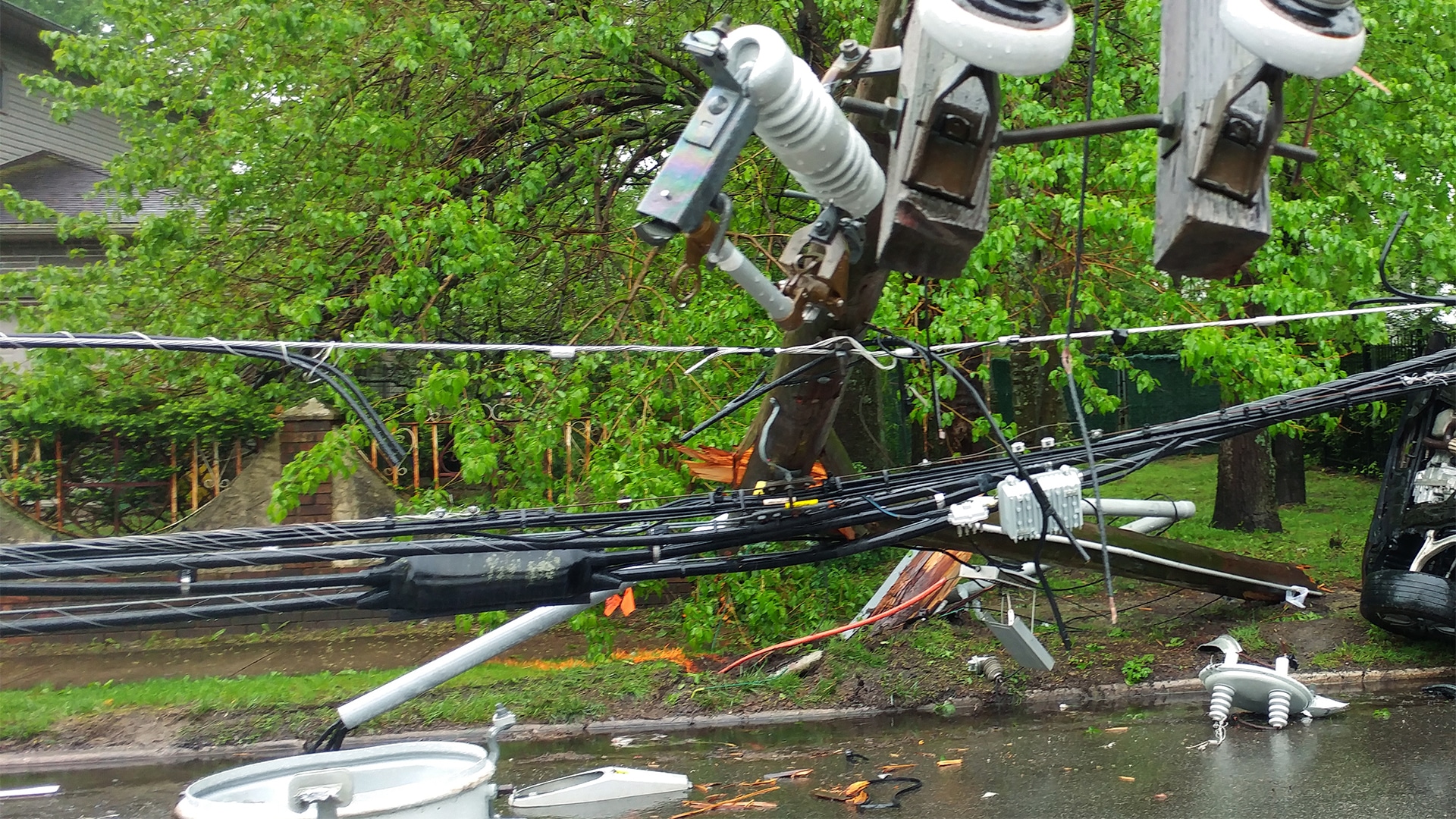
These “latent defects” include clearance violations, safety code non-compliance, and hidden overload conditions and may persist undetected until triggered by environmental stress events.
This gap is particularly significant given the scale and composition of distribution infrastructure. Estimates suggest there are 180 million utility poles in the U.S., with millions added or replaced annually due to growth, aging infrastructure, and storm damage5. Because the majority of distribution systems remain overhead, pole structural integrity represents a dominant—not marginal—component of system risk.
Why the gap exists (and persists)
Despite the importance of structural integrity, many utilities have historically operated without systematic PLA. Public data suggests that limited reporting requirements and lower levels of grid modernization investment may contribute to reduced adoption of advanced structural analytics tools in certain segments6.
Operational constraints also play a role. Traditional practices such as ground-line inspection programs provide valuable condition data but do not evaluate structural loading. At the same time, manual engineering calculations are time-intensive and prone to variability, limiting scalability across large systems.
Convergence of risk drivers
The risks of not performing pole loading analysis are no longer isolated. They are being amplified by multiple, interacting industry forces that are increasing both the likelihood of structural failure and the consequences when failures occur. What was once a localized engineering gap is now a system-level risk driver, compounded by regulatory expectations, infrastructure loading growth, environmental stressors, and legal and financial exposure. The forces include:
Wildfire and extreme weather risk
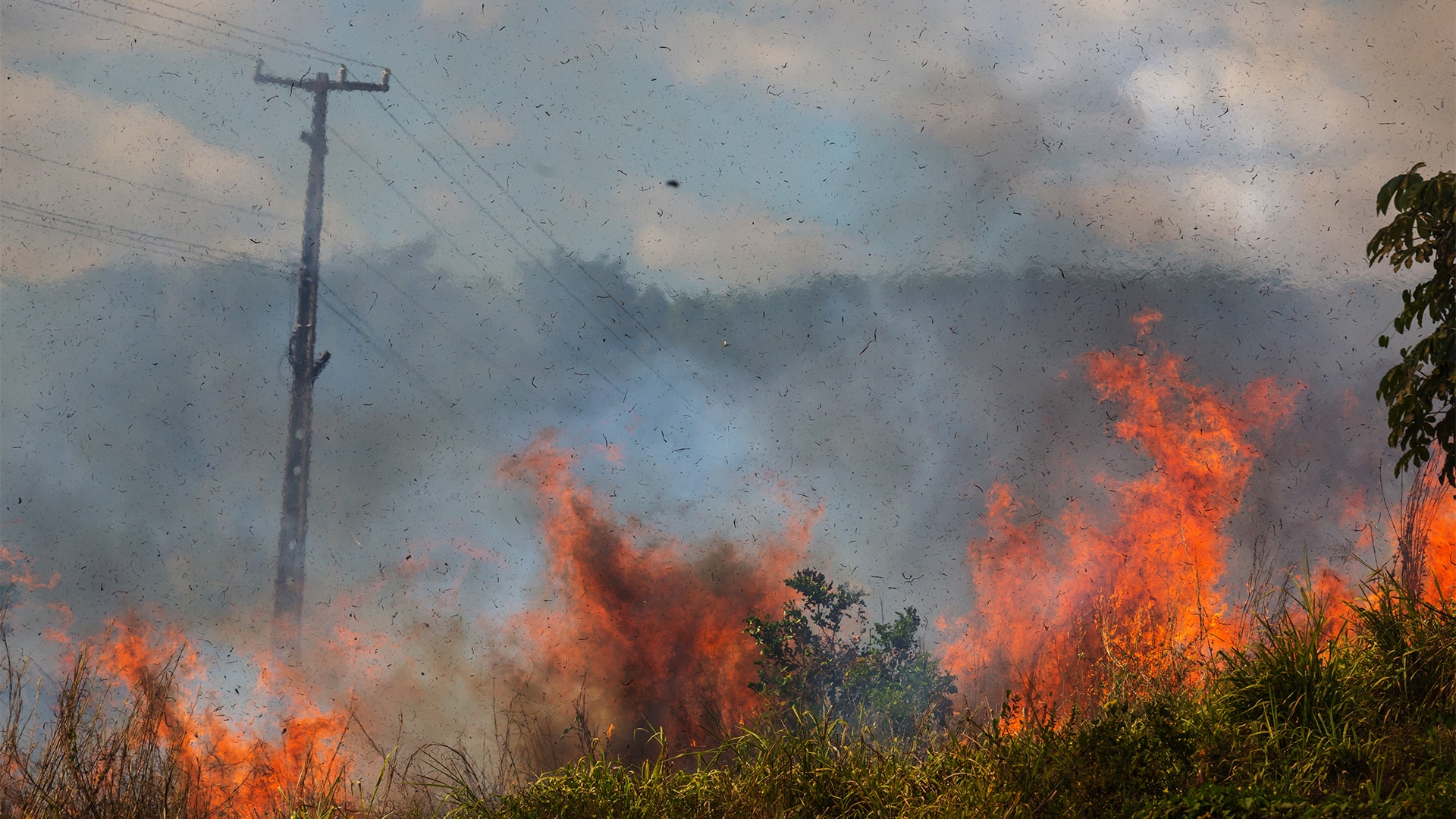
Wildfire mitigation regulations are expanding across multiple states. For example, California requires utilities to submit wildfire mitigation plans that address infrastructure risks and operational practices7, while Oregon and other states are implementing similar frameworks8,9. These regulatory structures require utilities to demonstrate how they identify and mitigate infrastructure-related ignition risk, an evidentiary requirement that inherently depends on structural analysis.
Joint-use and broadband expansion
Rapid broadband expansion is putting pressure on utility joint-use departments. Federal pole attachment rules emphasize engineering determinations related to capacity, safety, and reliability when new attachments are added to poles10. But a common gap among utilities is the failure to enforce the same rigorous standards for third-party attachments, creating inconsistency and risk. Without standardized PLA workflows, utilities face significant challenges in demonstrating that poles can safely accommodate additional loading.
Legal and judicial pressure
Recent litigation demonstrates how quickly structural integrity issues can become enforceable mandates. In the case of the Texas Smokehouse Creek fire, a court required large-scale pole inspection and replacement programs under defined timelines, effectively imposing operational requirements through legal action11.
Catastrophic event lessons
Events such as the 2023 Maui wildfire have drawn attention to the interaction between pole condition, structural loading, and environmental stressors. Reporting and ongoing investigations have examined potential roles of pole condition, conductor configuration, and wind loading12. These cases illustrate how structural uncertainty can translate directly into catastrophic outcomes.
These forces do not act independently; they compound. Increased attachment density raises structural loading, extreme weather increases stress on already marginal assets, and regulatory and legal frameworks increasingly require utilities to demonstrate that these risks are actively understood and managed. In this environment, the absence of PLA is not simply a lack of information; it is a lack of defensible insight into system condition under real-world loading scenarios.
Increasing legal exposure and regulatory scrutiny on distribution design engineering
A report by the Western Energy Institute (WEI)13 emphasizes that the standard of care is evolving as risks become more foreseeable and the regulatory environment becomes more demanding. Utilities may be held accountable not only for known issues but for conditions they reasonably should have identified through standard engineering practices. In this setting, pole loading analysis plays a critical role in addressing “constructive knowledge” risk by providing a routine, engineering-based method to evaluate whether poles meet current loading criteria under expected conditions such as wind, ice, and additional attachments. By regularly applying PLA, utilities can demonstrate that they are actively assessing infrastructure against known risks rather than relying on legacy assumptions or incomplete data.
The WEI analysis highlights that liability exposure for utility poles extends beyond simple ownership to include all entities with attachments, increasing the complexity of managing structural loading and responsibility13. In joint-use environments, where multiple parties share infrastructure, ambiguity in accountability can complicate both operations and litigation.
Tort-liability case examples tied directly to pole attachments and structural or clearance failures are widely documented and further illustrate these risks. WEI describes a severe injury case involving contact with a 7,200-volt line that resulted in a $29 million settlement, as well as a separate wildfire-related case in which overlashed communications lines failed and contacted an electric utility’s primary conductor, leading to a reported $740 million settlement13.
While these are not explicitly framed as “PLA cases,” they are, in practice, closely tied to the types of engineering considerations addressed through pole loading analysis—namely, attachment practices, structural loading, and clearance management. In each instance, the underlying legal theory of negligence connects engineering gaps or insufficient analysis to significant financial exposure.
Consistent engineering practices and standardized evaluation methods are necessary to ensure that cumulative loading conditions are properly assessed and documented across all attachments. In this context, pole loading analysis provides a structured mechanism to evaluate combined loading from all sources, enabling utilities to quantify capacity, identify overstressed conditions, and document how shared infrastructure is being managed in accordance with engineering standards.
Insurance market pressure
The insurance-related risk is not simply that premiums are rising across the board. Instead, the issue is that liability insurance can tighten significantly for utilities exposed to large-loss events, particularly wildfire risk. The WEI reports that utilities experiencing insurance challenges have seen substantial cost increases, the introduction of wildfire exclusions, and fewer insurers willing to provide coverage, creating operational pressure and, in some cases, cost impacts that may ultimately reach customers13. This reflects a direct relationship between infrastructure-related risk and the availability and affordability of insurance.
A Washington State Office of the Insurance Commissioner summary of a survey-based utility liability study14 reinforces these findings from a regulatory perspective. Utilities reported rising liability insurance costs, increasing use of wildfire exclusions, and a shrinking pool of insurers willing to write policies. Importantly, the report makes clear that these are not simply cyclical pricing effects but are tied to the potential for high-consequence damage claims. In other words, the insurance market is responding directly to the scale of risk exposure. Taken together, these sources show that engineering and operational risk, particularly related to infrastructure performance, translates into real financial constraints, increasing the importance of demonstrable risk mitigation.
As WEI highlights, liability exposure is not limited to pole owners13. In joint-use environments, responsibility can extend across multiple attaching parties, making it more difficult to clearly assign accountability when failures occur. This increases the importance of having a consistent and well-documented understanding of cumulative loading conditions.
Benefits of adopting PLA software
Standardization
A consistent theme emerging across industry guidance and regulatory frameworks is the need for standardized, repeatable engineering approaches to evaluating pole capacity and structural performance. Standardization reduces safety risk by minimizing safety code and clearance violations while also reducing organizational friction through consistent outputs across internal teams, contractors, and joint-use stakeholders. Effective pole loading analysis is not simply the adoption of software, but the implementation of standardized tools, methods, and data flows across the organization.
From a compliance standpoint, standardization helps translate the intent of the NESC into consistent engineering practice. The Code defines minimum strength and loading requirements under a range of conditions, but applying those requirements consistently across a large system requires more than reference to standards alone. Standardized PLA workflows embed construction grades, load cases, and strength factors directly into the analysis process, ensuring that each structure is evaluated against the same criteria. This is particularly important in joint-use environments, where incremental loading from additional attachments can gradually push structures beyond compliant limits if not systematically evaluated.
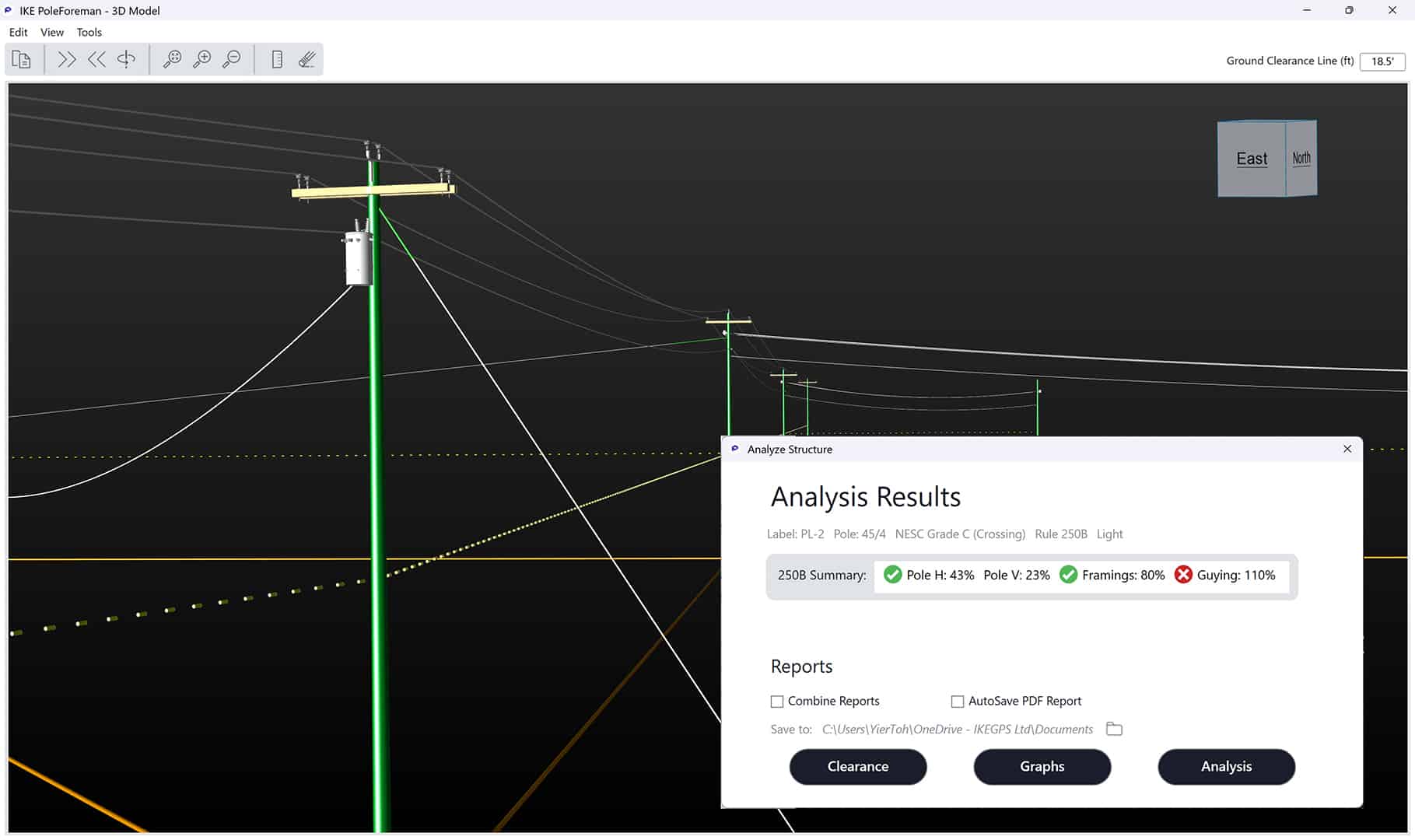
IKE PoleForeman PLA software helps ensure compliance with NESC and organizational standards.
Regulatory proceedings documented in the Federal Communications Commission Order on Pole Attachments (FCC 18-111)15 demonstrate that, in practice, large numbers of poles have exhibited preexisting issues when subjected to inspection, highlighting how inconsistencies in evaluating structural loading conditions can accumulate over time.
In practice, the value of standardized PLA workflows becomes most apparent when utilities must demonstrate how engineering decisions are made. It is one thing to assert that a structure is adequate; it is another to show, through consistent assumptions and calculations, how that conclusion was reached. That is where the notion of “defensible” analysis takes on real meaning, not as a marketing claim, but as an operational requirement. When PLA is embedded into routine workflows, design inspection follow-up, and joint-use permitting—it creates a repeatable record of structural evaluation, reducing reliance on individual judgment and improving consistency across the organization.
Save engineering hours
Pole loading analysis software automates calculations that were previously performed manually, enabling more rapid and consistent evaluation of pole capacity. In practice, utilities often rely on design standards as a proxy for structural adequacy; however, field experience shows that as-built conditions frequently deviate from those assumptions. Practitioners note that systems initially believed to meet internal standards may exhibit significantly different loading characteristics when evaluated through formal analysis, highlighting the limitations of manual or assumption-based approaches.
More broadly, industry experience indicates that PLA enables utilities to focus engineering efforts where they are most needed. Rather than defaulting to conservative or blanket replacement strategies, utilities can use analysis results to identify specific poles requiring reinforcement or replacement, reducing unnecessary design effort and capital expenditure. This targeted approach reflects a shift from assumption-based engineering to data-driven evaluation, improving both efficiency and reliability of decision-making.
Data and workflow integrations
Structural intelligence is a continuous workflow rather than a static report, linking field data collection to pole loading analysis and integrating results into GIS and enterprise asset management systems. Field activities, including inspections, emergency response, and joint-use assessments, serve as recurring opportunities to capture and reuse structural data across planning, design, and compliance workflows. This model reflects a broader shift toward integrated asset intelligence, where engineering analysis is continuously informed by updated field conditions.
The shift toward integrated structural intelligence is strongly supported by utility industry research. The Electric Power Research Institute (EPRI) emphasizes that modern distribution asset management depends on the integration of data across multiple systems, including GIS, inspection-data, performance metrics, and operational systems, to enable analytics, risk assessment, and decision-making at scale. EPRI further notes that GIS serves as a foundational “system of record” linking asset location, condition, and operational data, and that effective asset management requires coordination between GIS, work management, SCADA, and other enterprise systems to support planning and lifecycle decisions16.
Similarly, geospatial asset management research highlights that utilities must integrate data from multiple sources to build a complete and continuously updated model of the grid. For example, EPRI describes how modern utility workflows rely on combining field data, enterprise systems, and real-time inputs into a unified network model, enabling utilities to evaluate asset performance, predict failures, and prioritize investments based on risk and environmental conditions16. These capabilities include incorporating weather, geographic variability, and historical performance data, factors that are not feasible to evaluate using manual processes alone.
Taken together, these sources reinforce that PLA is most effective when embedded within an integrated data environment, where field observations, analytical models, and enterprise systems operate as a unified workflow. This integration enables utilities to move from reactive, point-in-time analysis toward continuous, data-driven assessment of structural capacity, supporting improved reliability, resiliency, and risk-informed decision-making.
Integrated PLA workflow
Nebraska Public Power District (NPPD) adopted a standardized digital process linking field data collection with pole loading analysis and asset records, resulting in improved data consistency and a significant reduction in joint-use review timelines17. The approach integrated field data into a centralized system that feeds directly into pole loading analysis, enabling more efficient and coordinated decision-making across engineering and permitting workflows.
Where to start
Start small
In practice, there is a clear pattern in how utilities start using pole loading analysis. It’s usually not a big, top-down rollout. Instead, it starts small, often with a specific project or a single engineer or team taking ownership. A lot of early friction isn’t technical, it’s cultural. People assume their existing standards are “good enough,” even though field conditions oftentimes conflict with those assumptions. Having a point person helps cut through that by providing the organization with a consistent approach to how analysis is performed and how results are interpreted.
The first step is typically a pilot that reflects day-to-day work. Engineers involved in these early efforts often rely on manual calculations and existing field references to establish a baseline. That process tends to be time-intensive, and confidence in the results can be limited, especially when dealing with complex loading scenarios or incomplete data. This creates a clear “before” picture that makes the benefits of a more standardized, software-supported approach easier to justify.
From there, the focus usually shifts to the most common construction scenarios. Utilities tend to standardize the cases they see most often, typical attachment configurations, conductor types, and installation practices. That reduces variability between engineers and contractors and makes the analysis more repeatable. It also reflects a basic reality: No two poles are the same, and relying solely on design standards does not fully capture how those differences affect structural loading.
Training and data quality quickly become central issues. If the inputs aren’t right, the results will not be either. Early adoption efforts often include targeted training, verification of field data, and an iterative feedback loop to improve consistency over time. As that process matures, confidence builds, not just in the tools, but in the overall workflow.
Prioritize high-risk assets
The next step in implementation is deciding where to focus first. In most systems, you will not run full pole loading analysis everywhere on day one, so the question becomes: Where does it matter most? From a risk standpoint, the priority should be locations where both the likelihood of failure and the consequences of that failure are high. That typically points toward areas with severe environmental loading, high attachment density, and assets that are already known—or suspected—to be in marginal condition.
Significant legal and operational consequences
In the case of the Texas Smokehouse Creek fire involving Xcel Energy, court proceedings have included proposed requirements such as accelerated replacement of poles identified as fire risks and ongoing compliance reporting while litigation continues over allegations that a broken distribution pole contributed to the 2024 event11. Reporting on the case also describes risk-tiered replacement timelines—such as addressing highest-priority poles within 24 hours. Whether or not those exact requirements become permanent, the direction is clear: Utilities are increasingly expected to identify structurally vulnerable assets before failure occurs and to prioritize remediation accordingly.
From a practical standpoint, there are a few categories that consistently rise to the top. The first is wildfire-prone or high-wind regions, where environmental loading can push already stressed structures past their limits. The second is areas with older infrastructure—poles that may be deteriorated, leaning, or otherwise degraded—especially when combined with significant attachment loading. A recurring challenge is that field conditions often don’t match original design assumptions, and that gap tends to show up most clearly under extreme conditions.
Another key category is joint-use corridors, particularly where broadband expansion and overlashing are occurring. Areas with active or pending attachment activity are natural candidates for early analysis, since decisions made there can either mitigate or compound future structural and compliance risks.
Prioritizing assets by risk-level allows utilities to get the most value from PLA early while also addressing the parts of the system with the smallest margin for error.
Combine with other projects
The most effective approach is not to treat pole loading analysis as a standalone task, but to tie it directly to existing field and engineering activities. Every field visit, whether it’s for inspection, joint-use review, storm response, or routine maintenance, is an opportunity to collect structural data that can support analysis. When data is captured in a consistent way and fed into a broader workflow, it becomes part of a system-level understanding of structural integrity.
A practical operating model is to connect PLA to existing inspection and permitting processes. For example, inspection cycles can be structured to include basic screening or preliminary stress checks, with full PLA triggered when those checks indicate potential overload or marginal conditions. This allows utilities to focus detailed analysis where it is most needed, rather than applying it uniformly across all assets.
This approach has two advantages. First, it reduces the need to create entirely new workflows, which is often where implementation efforts stall. Second, it improves data quality and coverage over time, since structural information is collected continuously as part of normal operations. One of the biggest missed opportunities is failing to capture usable data during field visits that are already being performed. Integrating PLA with these activities turns those visits into inputs for ongoing analysis rather than one-time observations.
Utilities that embed PLA into planned work are able to expand coverage quickly without overloading engineering resources, while also improving the consistency and usefulness of the data they collect.
Standardize contractors on selected software
When PLA processes advance beyond the pilot stage, consistency becomes the next real issue, especially when contractors are involved. Most utilities rely on a mix of internal teams and outside crews for design, inspection, and joint-use work. If those groups use different tools, assumptions, or data formats, you end up with results that don’t align. That makes it hard to compare loading conditions across the system or make consistent decisions.
Both federal pole-attachment rules and industry discussions point in the same direction on this topic. The rules make it clear that utilities are responsible for documenting engineering and capacity impacts, particularly when attachments are added or modified, and that poor practices can lead to safety or compliance issues. In practice, that means utilities benefit when contractors operate within a consistent framework, with the same expectations, the same general approach to loading calculations, and the same level of documentation. Otherwise, you are left trying to reconcile different answers to the same question after the fact.
Conclusion
Deferring pole loading analysis is no longer an acceptable course of action for utilities. Over time, the risk does not stay flat; it compounds. Attachments continue to accumulate, poles age, weather conditions shift, and the gap grows between what the utility thinks is on the pole and what is actually there in the field. That is exactly the kind of environment where overloads, safety code violations, and weak structures can sit undetected until a storm, an accident, or an attachment project exposes them.
The legal and institutional side is shifting from assumption-based distribution design to direct evaluation of as-built conditions and pole loading. Negligence claims are not decided only on whether a pole failed; they turn on whether the utility can show it exercised reasonable care consistent with industry standards and codes. Failure to comply with applicable codes or to demonstrate adequate inspection and oversight can translate into large settlements or punitive damages. After major events, that scrutiny can quickly turn into operational mandates.
Operationally, the answer is not simply “do more studies.” The answer is to integrate PLA into work that utilities are already doing. Field visits, whether inspections, joint-use work, or storm response, should be treated as opportunities to gather structural data, not one-off events. When that data is captured consistently and tied into analysis workflows, utilities start to build a system-level understanding of structural intelligence instead of relying on fragmented information.
This is where modern PLA workflows become important. Tools such as IKE PoleForeman and supporting field data platforms are designed to connect field collection, structural analysis, and asset records into a single process.
PLA is only as reliable as the field data and as-built conditions behind it. The quality of the result still depends on the quality of the field data, condition inputs, and code assumptions. If the inputs are wrong, the outputs will be too. That is not an argument against PLA; it is an argument for doing it in a disciplined, repeatable way. The real value is that PLA converts a dangerous unknown into something engineering can work with: quantified, documented, and prioritized structural risk.
Utilities that continue to treat pole capacity as a design assumption are allowing risk to build quietly in the background. Utilities that treat pole capacity as a managed asset attribute, supported by consistent data collection, standardized analysis, and integrated workflows, are in a much better position to reduce catastrophic risk, justify capital decisions, and demonstrate due diligence under regulatory and legal scrutiny.
How IKE can help
Field data collection and management: IKE Device + IKE Office Pro
IKE’s cloud-based software enables you to measure and manage pole records and serves as a centralized, accessible platform for collaboration between fielding, back office, and third parties. IKE Office Pro is equipped with features to enhance your existing workflows, including automating the time-consuming competitive task of annotating pole imagery. Through reporting, API’s, and an array of export features, IKE Office Pro integrates field data with downstream processes and applications.
Pole loading analysis: IKE PoleForeman
IKE PoleForeman has been the industry standard for delivering accurate and reliable pole loading analysis for nearly two decades. Build reliable structural models, measure span clearances, and ensure NESC compliance on an easy-to-use interface.
Training & education: IKE's NESC Classes
IKE’s training offerings take the complex and often hard-to-understand Code and transform it into practical, relatable information that can be applied to daily utility work. Classes are presented in-person or online.
References
- Beehler, Mike. Distribution Goal: 50% Underground by 2040. T&D World.
https://www.tdworld.com/smart-utility/article/21253499/distribution-goal-50-underground-by-2040 - Florida Public Service Commission. (2019, July 29). Order No. PSC-2019-0302-PAA-EI: Storm hardening plan approval [PDF].
https://www.psc.state.fl.us/library/Orders/2019/06087-2019.pdf - Brown, R. E. Electric Power Distribution Reliability. 2nd ed. Boca Raton, FL: CRC Press, 2008.
- ikeGPS. “National Grid Creates a More Climate-Resilient Grid with Accurate Pole Loading Analysis.”
https://ikegps.com/casestudies/national-grid-creates-a-more-climate-resilient-grid/ - Mountain View Electric Association. Rooted in Resilience: The Story of Wooden Utility Poles.
https://www.mvea.coop/news-releases/rooted-in-resilience-the-story-of-wooden-utility-poles/ - Warwick, W. M., Hardy, T. D., Hoffman, M. G., & Homer, J. S. (2016). Electricity Distribution System Baseline Report (PNNL-25178). U.S. Department of Energy / Pacific Northwest National Laboratory.
https://www.energy.gov/sites/default/files/2017/01/f34/Electricity%20Distribution%20System%20Baseline%20Report.pdf - California Legislature. (n.d.). Public Utilities Code § 8386: Wildfire mitigation plans.
https://leginfo.legislature.ca.gov/faces/codes_displaySection.xhtml?lawCode=PUC§ionNum=8386 - Oregon Public Utility Commission. (n.d.). Wildfire mitigation program. https://www.oregon.gov/puc/safety/pages/wildfire-mitigation.aspx
- National Conference of State Legislatures. (2025, October 28). Wildfire mitigation plans, state funding pools and public safety power shutoffs.
https://www.ncsl.org/energy/wildfire-mitigation-wildfire-mitigation-plans-state-funding-pools-and-public-safety-power-shutoffs - Federal Communications Commission. (2018, September 14). Accelerating wireline and wireless broadband deployment by removing barriers to infrastructure investment. Federal Register.
https://www.federalregister.gov/documents/2018/09/14/2018-19547/accelerating-wireline-and-wireless-broadband-deployment-by-removing-barriers-to-infrastructure - Penrod, E. (2026, February 26). Xcel must begin pole replacement in Texas as court weighs Smokehouse Creek fire lawsuit. Utility Dive.
https://www.utilitydive.com/news/xcel-must-enact-pole-replacement-plan-in-texas-as-court-weighs-smokehouse-c/813176/ - McDermott, J., Condon, B., & Biesecker, M. (2023, August 26). Bare electrical wire and leaning poles on Maui were possible cause of deadly fires. Associated Press.
https://apnews.com/article/hawaii-wildfires-maui-electricity-power-utilities-9f23f79821ea50256f0725ac9b0b3905 - Western Energy Institute. (2024, March 13). Mitigating tort liability for utility pole owners and occupants.
https://www.westernenergy.org/resource/mitigating-tort-liability-for-utility-pole-owners-and-occupants/ - Washington State Office of the Insurance Commissioner. (2023, January 19). New report on utilities’ liability market reveals increased costs, coverage exclusions.
https://www.insurance.wa.gov/about-us/news/2023/new-report-utilities-liability-market-reveals-increased-costs-coverage-exclusions - Federal Communications Commission. Accelerating Wireline Broadband Deployment by Removing Barriers to Infrastructure Investment. FCC 18-111, August 2018.
https://docs.fcc.gov/public/attachments/FCC-18-111A1.pdf - Simmins, John, Monetizing the Geospatial Information System (GIS): The Value of GIS Data Quality for Electric Utilities, Palo Alto, EPRI. CA: 2012.1024303. Access:
https://www.epri.com/research/products/000000000001024303.%20 - ikeGPS. NPPD Increases Joint-Use Efficiency While Improving Safety, accessed 2026,
https://ikegps.com/casestudies/nppd-increases-joint-use-efficiency-while-improving-safety/
About IKE
We’re ikeGPS, the PoleOS™ Company. We help electric utilities, communications companies, and their engineering providers gain actionable insights on overhead infrastructure. Our data acquisition and analysis solutions transform how to design, construct, and inspect overhead assets. With two decades of industry expertise, IKE has become the standard for eight of the 10 largest investor-owned electric utilities in North America.
Table of contents
- Introduction
- PLA in utility planning, design, and compliance workflows
- From “unknown unknowns” to quantified risk
- The need for proactive, targeted mitigation efforts reinforced by data
- Structural risk: The missing layer in utility asset intelligence
- Why the gap exists (and persists)
- Convergence of risk drivers
- Increasing legal exposure and regulatory scrutiny on distribution design engineering
- Insurance market pressure
- Benefits of adopting PLA software
- Where to start
- Conclusion
- How IKE can help
IKE helps utilities manage risk by developing integrated structural analysis processes
Related Resources

NPPD increases joint-use efficiency while improving safety
NPPD standardized on IKE and was able to improve data collection, pole load analysis, and data standards resulting in a significant reduction in the review...
Read Now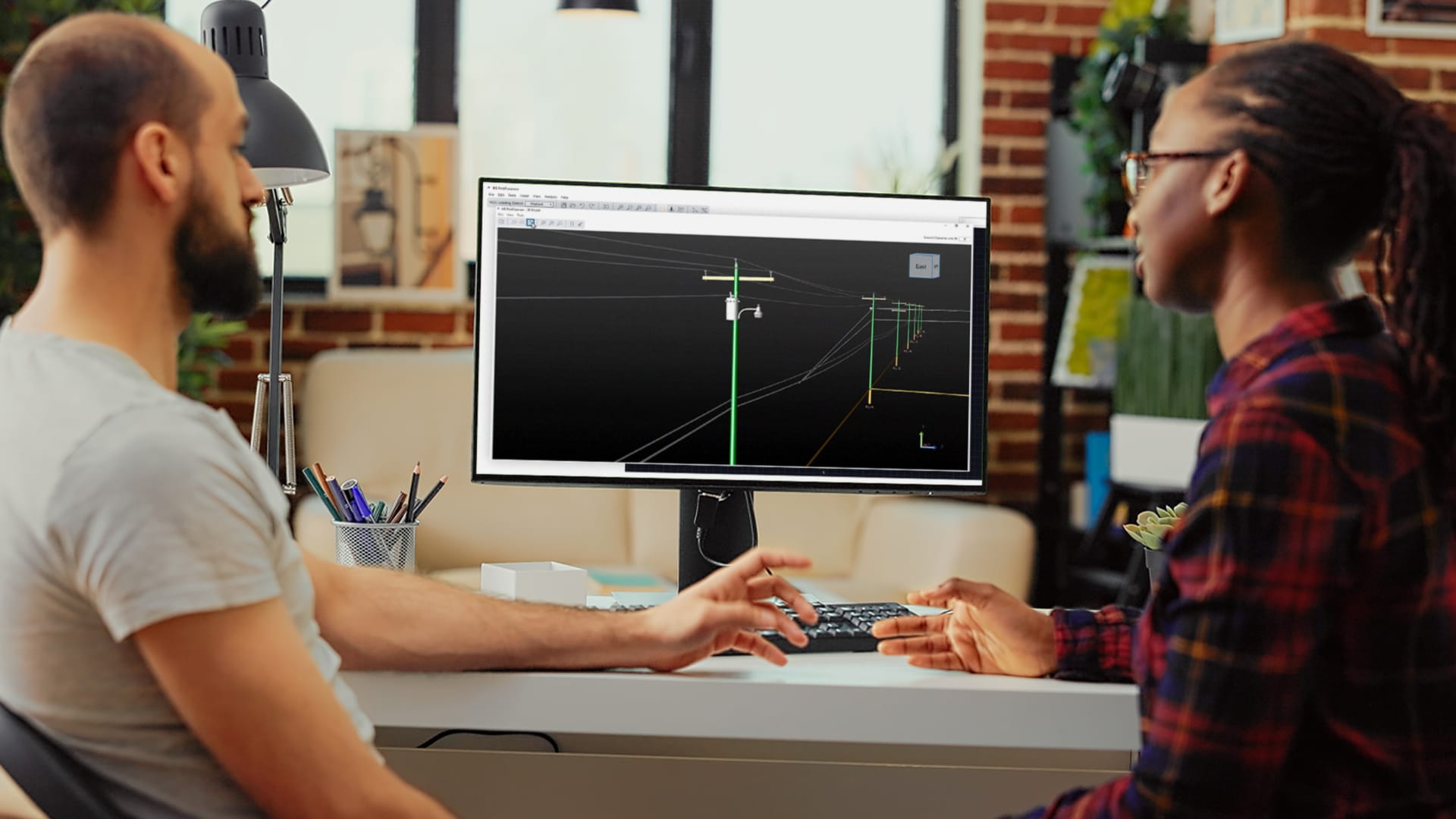
What to consider when evaluating pole loading analysis software
Making the right decision affects everyone in your ecosystem When a utility selects a pole loading analysis (PLA) solution, they're not just making a software...
Read Now
Video chat: Challenges and opportunities for Power Delivery leaders (part 1)
Overview Energy industry expert and author, Peter Kelly-Detwiler, moderates a discussion with Dennis Elsenbeck, head of the energy practice at Phillips, Lytle LLP and former...
Read Now