The PoleOS™ Company



The growing stakes of pole loading analysis compliance for distribution design engineers
Increasing scrutiny on electric utilities means PLA is becoming a critical process
If you’re a distribution design engineer at an electric utility, pole loading analysis (PLA) has probably lived somewhere on the fringes of your workflow — triggered by a joint-use application, a storm hardening project, or a one-off field anomaly. That’s changing fast. PLA is rapidly moving from engineering due diligence to a core risk management function, and the pressure is coming from multiple directions at once.
Here’s what you need to understand about where things stand — and why your role matters more than ever.
The forces converging on your design practice
Several industry trends are simultaneously raising the stakes for pole loading compliance and compounding one another.
Wildfire and extreme weather regulations are expanding across multiple states. California, Oregon, and other states now require utilities to submit wildfire mitigation plans that address infrastructure ignition risk — an evidentiary requirement that depends on structural analysis. Engineers in these regions need to demonstrate that infrastructure has been evaluated under real-world loading conditions, not just design assumptions.
Broadband expansion and joint-use growth are adding attachment density to distribution poles that may already be operating with limited structural capacity. Federal pole attachment rules require engineering calculations about capacity and safety before new attachments are added. Without a standardized PLA workflow, it’s difficult to consistently demonstrate compliance as attachment requests accumulate.
Legal and regulatory pressure is escalating. In the Smokehouse Creek fire case in Texas, a court ordered accelerated pole replacement programs with risk-tiered timelines under active litigation. Elsewhere, wildfire-related settlements have reached hundreds of millions of dollars. The legal theory in these cases consistently links engineering gaps — inadequate structural evaluation, unclear documentation of attachment impacts — to negligence claims.
From “Is this acceptable?” to “What is the actual load?”
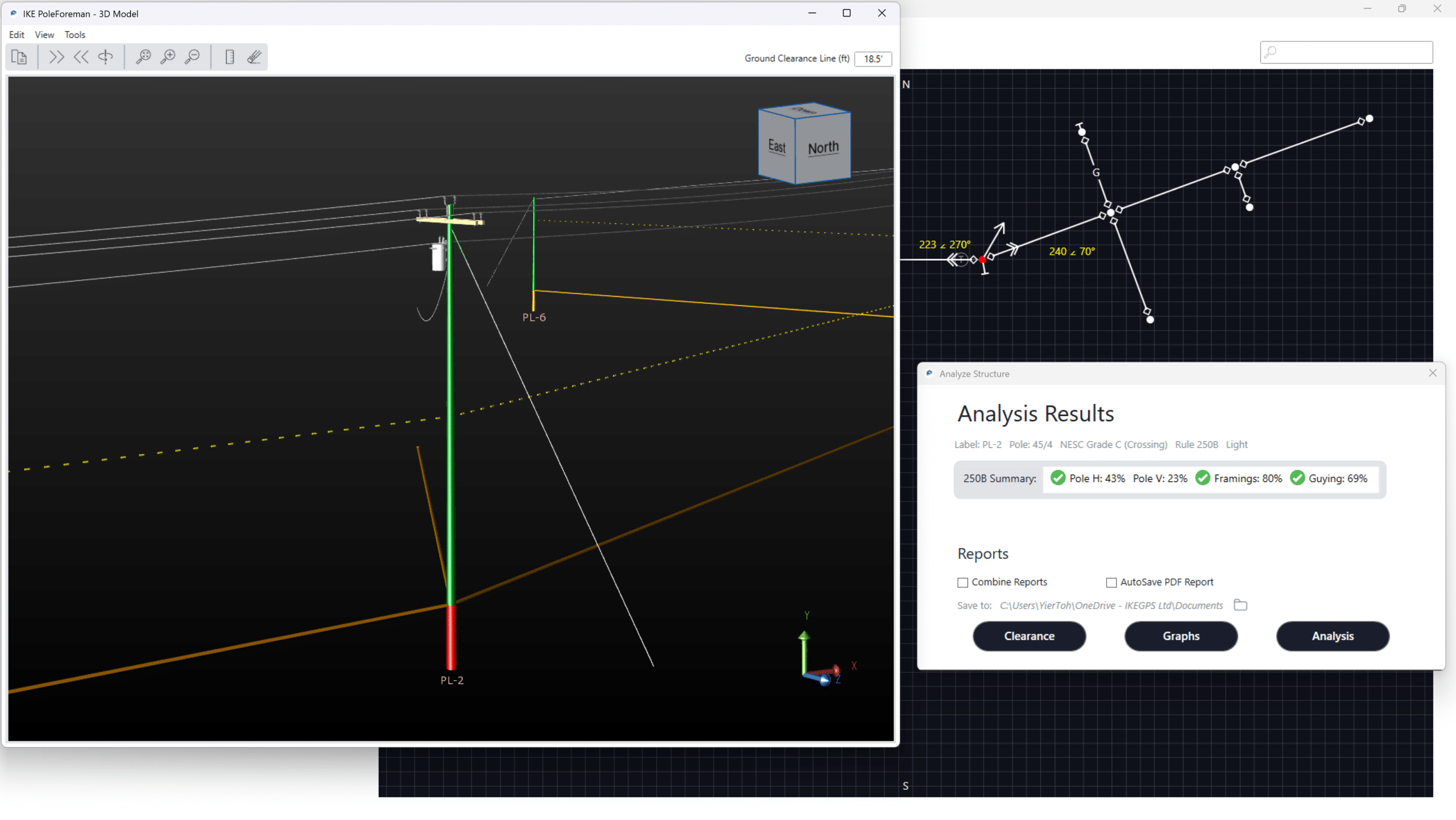
This is the core shift PLA enables. The National Electrical Safety Code (NESC) defines minimum strength and loading requirements across a range of conditions; however, applying those requirements consistently across a large distribution system requires more than a reference document. PLA evaluates each structure using as-built geometry, attachment configuration, and applicable NESC loading cases to calculate actual load relative to allowable limits.
That moves the conversation from “Is this pole probably fine?” to “What is the actual load, and how close is this structure to its NESC limit?” That precision matters for more than compliance. When PLA outputs are combined with location data — wildfire-prone zones, feeder criticality, attachment density — you can rank structures by both probability and consequence of failure. With those insights, you can direct limited reinforcement and replacement budgets where they’re needed most.
Documentation is part of the work
One aspect of PLA that often gets undervalued is the audit trail it creates. Standardized PLA workflows embed construction grades, load cases, and NESC strength factors directly into the analysis process, ensuring every structure is evaluated against the same criteria. Every analysis then documents the assumptions, loading conditions, and results used to reach a conclusion at a point in time. In an environment of increasing regulatory scrutiny and litigation exposure, traceability is critical. Documentation closes the gap between asserting that a pole was adequate and demonstrating, through consistent methodology, exactly how that determination was made.
Where to start
You don’t need a system-wide rollout to get started. Most successful implementations begin with a pilot tied to work already in progress — a joint-use project, an inspection cycle, a design task force. The goal is to establish a repeatable, standardized process for the most common loading scenarios in your system. From there, prioritize areas with the highest structural risk: wildfire-exposed circuits, corridors with active broadband buildout, and aging assets in high-load environments.
The biggest opportunity most utilities miss is using routine field visits for a single purpose. Every inspection, permitting review, or storm response is a chance to capture structural data that feeds ongoing analysis. When field data collection is integrated with PLA and tied into GIS and asset management systems, you’re building structural intelligence, not just completing a work order.
Read our white paper, Pole loading analysis: From engineering due diligence to core risk management
Matt Cain is a Director of Product Management for ikeGPS. Matt has spent more than 18 years in the utility and software industries with experience in field data collection, training, software implementation, and product management. He holds a BA in Integrated Social Studies from The Ohio State University.

The latest from the IKE Wire
IKE Q3 2026 product updates
Over the last quarter, we added even more efficiencies to your field-to-finish workfl...
Read MoreNESC requirements for fiber-optic cables in the supply space
As a member of National Electrical Safety Code (NESC) committees and IKE’s NESC tra...
Read MoreHow to choose the right OSP data collection solution
Comparing five OSP field technologies and the common use cases they support When it c...
Read MoreSubscribe to the IKE Wire
Get the latest insights on data acquisition and structural analysis from the ikeGPS experts.