The PoleOS™ Company


Storm hardening starts with data
Updated September 8, 2026

As the effects of climate change become more evident, electric utilities are facing an increased risk of weather-related events that cause power outages. Severe storms, hurricanes, tornadoes, and other natural disasters can all cause significant damage to grid infrastructure, leading to extended service interruptions and substantial economic costs.
In response, utilities are adopting storm-hardening measures to improve the resilience of their systems and minimize the impact of weather-related events.
This article explains how storm hardening strengthens grid resilience, why accurate infrastructure data matters, and how structural analysis helps engineering teams identify needed upgrades.
Key highlights:
- Storm or grid hardening strengthens power infrastructure against severe weather through measures such as reinforcing lines, replacing or upgrading vulnerable assets, undergrounding lines, and improving system design.
- Accurate asset, structural, location, and hazard data supports better hardening decisions by helping engineering teams identify vulnerabilities, assess pole capacity, prioritize investments, and avoid unnecessary upgrades.
- IKE PoleForeman supports storm hardening planning by delivering pole loading analysis results that enable utility engineering teams to model structural capacity, identify poles at risk under design conditions, and determine whether structures need reinforcement or replacement.
What is storm hardening?
Also known as grid hardening, storm hardening is the process of changing the design, construction, and operation of power systems to reduce their vulnerability to weather-related events. These modifications may include:
- Reinforcing transmission and distribution lines
- Burying power lines
- Installing backup power sources
- Improving communication systems
The reliability record explains the urgency in dealing better with storm exposure. The most recent national figures from the U.S. Energy Information Administration (EIA) show customers averaged about 11 hours without power in 2024, the most in a decade and nearly twice the average of the preceding 10 years. Hurricanes Beryl, Helene, and Milton accounted for 80% of all interruption hours that year.
5 key benefits of storm hardening
A well-planned storm hardening program improves reliability, reduces infrastructure risk, and helps utilities direct capital toward the assets that need it most. The benefits extend beyond the immediate effects of severe weather and support broader grid planning and modernization efforts.
- Less infrastructure damage during severe weather: Targeted upgrades strengthen poles, conductors, and other assets against high winds, ice, flooding, and other hazards.
- Fewer and shorter outages: Stronger infrastructure lowers the likelihood of failures (SAIFI) and helps limit the extent of storm-related outages (CAIDI/SAIDI).
- Faster storm response and restoration: Fewer and less severe failures reduce the amount of repair work crews must complete after an event.
- Capital directed at the highest-risk assets: Field data collection, asset condition, environmental exposure, and structural analysis can help identify where hardening investments may have the greatest impact.
- Better reliability for critical facilities and the communities they serve: Hardening the infrastructure that serves hospitals, emergency services, water systems, and other critical facilities reduces their exposure to storm-related disruptions.
What is the importance of data in storm hardening?
Without accurate and reliable data, utilities may implement ineffective or incomplete measures that fail to adequately address vulnerabilities in their system. In some cases, utilities may even make decisions based on faulty information, leading to costly and unnecessary investments in storm hardening.
Utilities must understand their grid vulnerabilities to implement effective storm hardening measures. This expertise requires two tasks:
- Collecting and analyzing data on the grid performance during weather-related events.
- Identifying areas of weakness (for example, utilities usually have certain areas within their service territories that experience more frequent outages).
There can be many reasons for power outages, but pole failures resulting from too much load at the top of the pole are a common one. As poles accommodate more power equipment and conductors within the supply space, the added load increases the stress on the structure during inclement weather.
Frequent and accurate inspection of the system is necessary to determine the size of the problem. Utilities can then use the field data to develop comprehensive storm hardening strategies that address vulnerabilities and reduce the risk of power outages.
What data does a storm hardening program need?
Storm hardening decisions require a mix of asset, structural, location, and hazard data from your poles. Together, these inputs help engineering teams identify vulnerable infrastructure, assess structural capacity, and prioritize upgrades.
| Pole data category | Examples of what is included | Why is this data important |
|---|---|---|
| Pole information |
|
Establishes the baseline capacity every load counts against. |
| Attachments |
|
Height and weight of attachments are used to calculate clearances and loading. |
| Span geometry |
|
Determines the direction and magnitude of force on the structure |
| Location |
|
Indicates which NESC Weather Loading (wind and ice cases) the pole has to be designed against. |
| Capture date |
|
Used to verify whether the record still matches the pole today. |
How utilities turn field data into storm hardening decisions
To ensure good data for storm hardening, utilities must invest in monitoring and field data collection technologies. Field data collection solutions like the IKE Device combine multiple tools such as GPS, laser rangefinder, calibrated image capability, and a user-friendly app to capture pole information. Such technology reduces the possibility of human error from manual calculations and improves safety by eliminating the need for data collectors to carry a heavy Hastings stick in the field.
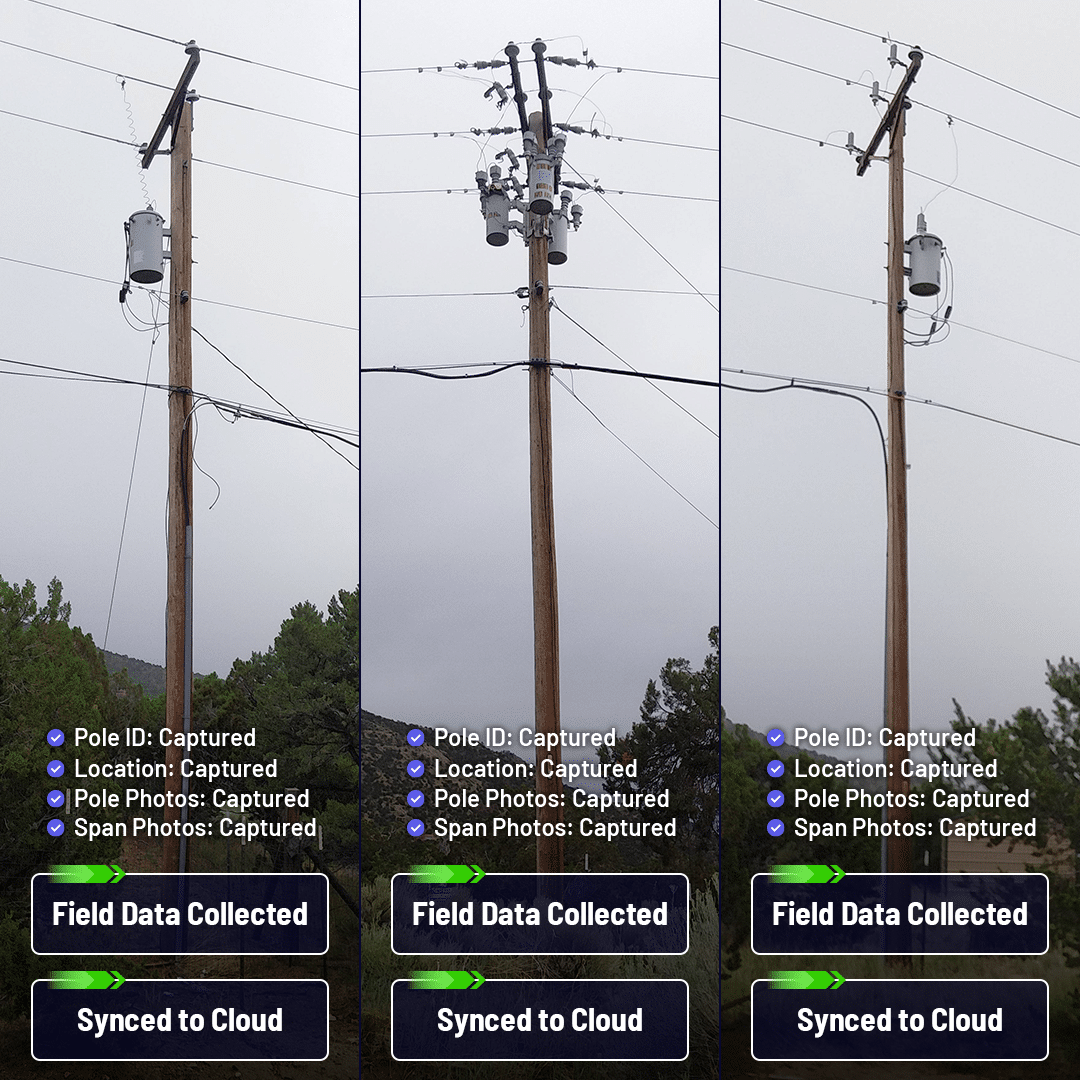
Back in the office, pole loading software allows for the thorough and accurate examination of the data acquired in the field and the subsequent construction of accurate network models. With pole loading analysis conducted with software such as IKE PoleForeman, utilities perform detailed structural examinations to identify areas of their distribution network that might be at greater risk in a severe weather event. Engineering teams can also add the inspection results into the utility’s Geographic Information System (GIS).
GIS data provides a comprehensive view of the power system, including the location and condition of power lines, transformers, substations, and other critical infrastructure, as well as potential vulnerabilities to weather-related events. By analyzing the information with IKE PoleForeman or another PLA software, a utility can see which structures fail under a design storm and decide whether to reinforce or replace them.
Engineering teams can also use GIS records to enable additional storm hardening strategies, such as the placement of backup power sources and the reinforcement of power lines.
A grid hardening case study: Florida Power & Light (FPL)
One example of a utility that has invested heavily in grid hardening and data collection is Florida Power & Light (FPL). Their comprehensive storm hardening program included installing more than five million smart meters, which provide real-time data on power consumption and grid performance.
FPL has also invested in advanced weather modeling tools that allow them to predict the impact of hurricanes and other weather-related events on their power systems. By using this data to inform storm-hardening strategies, FPL has been able to significantly improve the storm resilience of their network and minimize the impact of weather-related events.
Explore more case studies and see how National Grid uses IKE PoleForeman to assess wind and ice cases and identify where asset improvements should focus.
Build storm hardening programs on accurate pole data
When you combine accurate field information and pole loading analysis, you get better storm hardening strategies, such as the placement of backup power sources and the reinforcement of power lines.
The use of data from GIS and IKE’s utility-focused solutions in grid hardening can:
- Improve the resilience of power systems.
- Reduce the weather-related economic costs associated with power outages.
- Ensure the safety and well-being of communities during weather-related events.
For utilities running hardening programs across multiple engineering partners, IKE PoleForeman also serves as the standardization layer: one analysis platform, a set of design standards, and comparable results regardless of who collected the data.
John J. Simmins is the Executive Director of the NYS Center for Advanced Ceramic Technology (CACT) at Alfred University. In this position, he supports sponsored research for approximately 50 engineering faculty and 50 graduate students. Alfred provides undergraduate and graduate degrees in Renewable Energy Engineering, Mechanical Engineering, as well as Glass and Ceramic Engineering. Dr. Simmins spent ten years at EPRI as a Technical Executive before going to Alfred. At EPRI he studied the intersection of augmented reality, artificial intelligence, and geospatial information systems. He holds a B.S. and Ph.D. in Ceramic Engineering from Alfred University.
frequently asked questions
Storm hardening vs. grid hardening: What is the difference?
Both storm and grid hardening describe the same work. Either term still resolves to one engineering question: which structures fail under certain conditions and which hold.
- Storm hardening is the language of state utility regulatory filings, particularly in hurricane-exposed states.
- Grid hardening is broader, and usually appears alongside grid resilience, wildfire mitigation, and modernization programs.
How do utilities decide which circuits or poles to harden first?
Utilities typically prioritize circuits and poles based on outage history, asset condition, customer impact, critical facilities served, and exposure to severe weather. They can then combine those factors with structural analysis to identify assets with limited capacity or a higher risk of failure under design conditions.
What makes pole data reliable enough for storm hardening analysis?
Pole data needs to reflect the structure as it exists in the field. Utility pole data collection solutions capture the information you can’t miss in a storm hardening analysis, such as:
- Pole dimensions
- Attachment heights
- Span geometry
- Guying
- Location
Missing or outdated attachments, framing changes, or span information can alter the calculated load on a pole and lead engineering teams to make hardening decisions from an incomplete structural model.
Can existing pole records be used for a hardening program, or does everything need to be re-surveyed?
The reuse of pole records for grid hardening depends on what has changed since the first analysis. Records created before new communications attachments, a reconductoring project, or a framing change may no longer reflect the pole’s current state.
In practice, utilities can prioritize:
- Existing records for circuits with little attachment or construction activity, where the available data is more likely to reflect current conditions.
- New field surveys for circuits with significant joint-use or construction activity, where structural loading may have changed.
Attachment permit and construction history help identify where existing records remain reliable and where engineering teams need to perform a new collection. By doing this reuse analysis, engineers base hardening decisions on current pole conditions and avoid reinforcing or replacing structures using outdated information.

The latest from the IKE Wire
NESC requirements for fiber-optic cables in the supply space
As a member of National Electrical Safety Code (NESC) committees and IKE’s NESC tra...
Read MoreHow to choose the right OSP data collection solution
Comparing five OSP field technologies and the common use cases they support When it c...
Read MoreThe IKE Device now supports staking and a lot more utility fielding workflows
The latest round of IKE Device updates expands the scope of what a single field data ...
Read MoreSubscribe to the IKE Wire
Get the latest insights on data acquisition and structural analysis from the ikeGPS experts.