The PoleOS™ Company



Pole loading analysis as a risk management strategy for utilities
How to turn uncertainty on distribution asset health into quantified, manageable risk
Many electric utilities still rely on asset management practices developed for an earlier era: ground-line inspections that check for decay but not structural loading, distribution standards created decades ago, and run-to-fail mentalities.
That results in a major data gap on distribution asset health. Operational datasets, including outage history, performance metrics, and asset age, only give paint part of the picture. The critical missing layer is verified structural loading data.
The good news is that pole loading analysis (PLA) has matured into a practical, scalable solution for converting uncertainty into quantified, manageable risk. What was once treated as optional engineering due diligence is becoming a core risk management strategy. And it’s a strategy that regulators, insurers, and courts increasingly expect utilities to have in place.
Assessing Distribution System Risk: What You Don’t Know Can Hurt You
Operational performance metrics tell you how your system has behaved in the past. They do not tell you how it will hold up under a 90 mph wind event or if a new broadband provider overbuilds your system.
Without standardized pole loading analysis, utilities face overloaded structures, clearance violations, and safety code non-compliance. All of these may sit undetected until triggered by an extreme weather event, a field incident, or a regulatory audit. By then, the cost of discovery is far higher than the cost of proactive analysis would have been.
A Convergence of Risk Drivers is Raising the Stakes
The risks of skipping PLA are being amplified by several intersecting industry forces:
Wildfires
Wildfire risk management is no longer confined to a season; it is a daily operational variable for utilities. NOAA’s Climate Prediction Center projects above-normal wildfire risk across much of the western U.S. for the foreseeable future. This prediction is driven by persistent drought, earlier snowmelt, and drier vegetation conditions which extend the traditional fire season on both ends.
The 2023 Maui wildfire and the 2024 Texas Smokehouse Creek fire have drawn attention to how pole condition, structural loading, and environmental stress interact. In the Smokehouse Creek case, a court required Xcel Energy to begin accelerated pole inspection and replacement under defined timelines—an operational mandate imposed through litigation, not regulation.
As risk intensifies, utilities are increasingly being asked to demonstrate how they identify and mitigate infrastructure-related ignition and have data to back it up.
Severe Weather
Severe storms—hurricanes, derechos, ice storms, and high-wind events—are growing in frequency, duration, and intensity. According to research by Climate Central, the years 2023, 2024, and 2025 held the top three counts of disasters with at least $1 billion in damages since 1980 (adjusted for inflation).
The compounding effect of aging infrastructure makes this all the more difficult for utilities. More than 70% of the U.S. electrical grid is over 25 years old and not designed for the severity or frequency of weather events that we see today.
Joint-Use and Broadband Expansion
Federal broadband infrastructure investment is driving a surge in new pole attachment requests. Every new attachment changes the structural equation for that pole. Yet a common gap among utilities is the failure to consistently enforce attachment standards. This includes ensuring that joint-use teams follow the same standards as internal design and standards engineers, as well as holding third-party attachers to those same standards. This inconsistency creates latent defects that can accumulate quietly until environmental stress exposes them.
Without standardized PLA workflows, utilities cannot reliably demonstrate to attachers, regulators, or courts that their poles can safely accommodate additional loading.
Compliance with Safety Standards
The National Electrical Safety Code (NESC) defines minimum strength and loading requirements for utility poles across a range of wind and ice loading conditions. Applying those requirements consistently across a large, varied, complex distribution system requires more than Code familiarity; it requires a standardized process. Standardized PLA workflows consistently apply Code requirements, ensuring that every structure is evaluated against the same criteria.
PLA as a Risk Mitigation Strategy
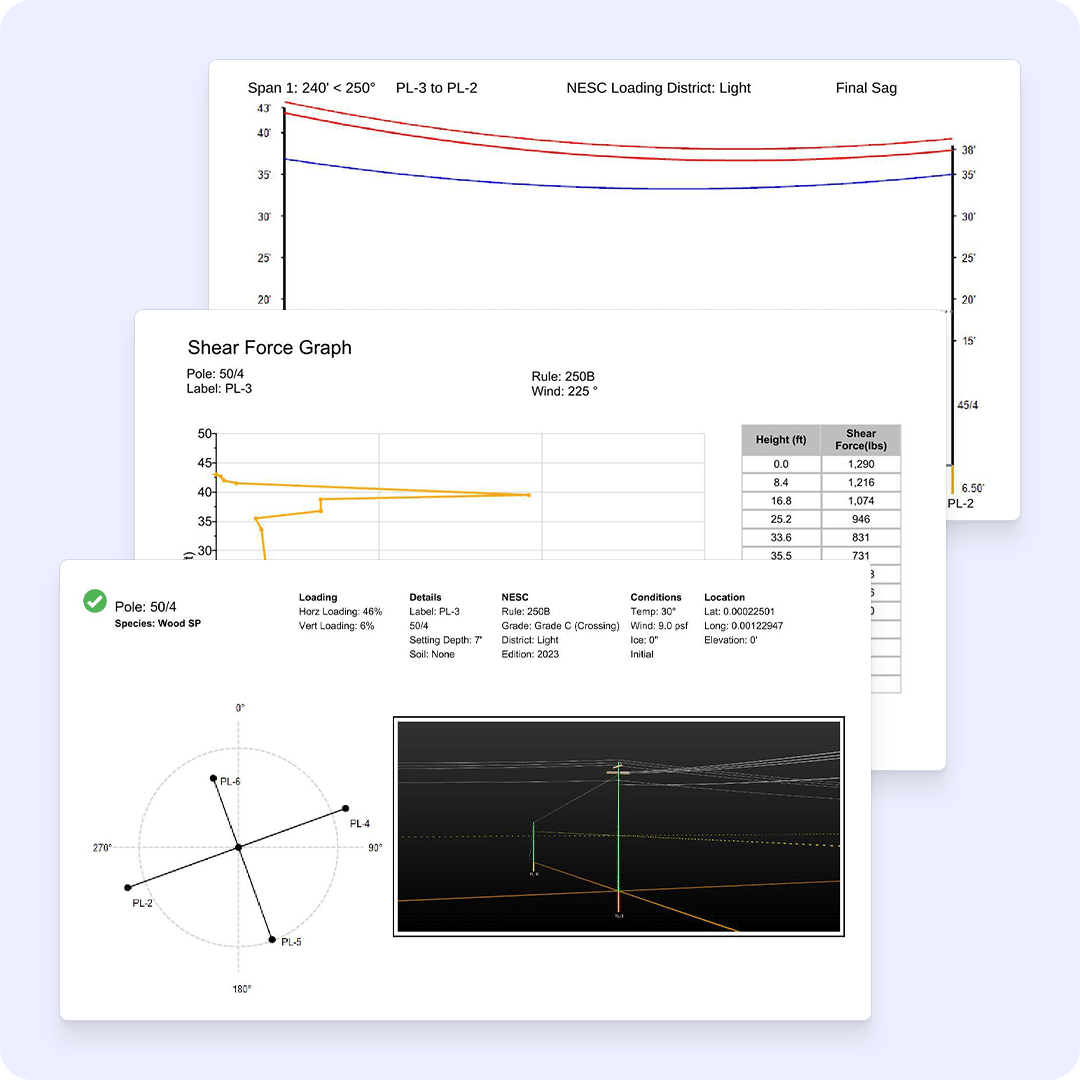
When it comes to managing distribution asset risk, there’s no replacement for pole loading analysis. PLA evaluates a structure using as-built geometry, attachment configuration, and applicable loading conditions against NESC requirements.
Shifting from assumption-based engineering to data-driven evaluation has far-reaching operational benefits:
- Defensible documentation: Each analysis creates a traceable record of what was known, what was evaluated, and why a particular decision was made. In an environment where joint-use complexity, regulatory scrutiny, and legal exposure are all increasing, this level of documentation is essential.
- Proactive, targeted capital investment: Rather than applying blanket replacement strategies, utilities can identify the specific poles requiring reinforcement and prioritize by probability and consequence of failure. National Grid, for example, uses PLA as a core component of its inspection and maintenance program to identify vulnerable assets and prioritize grid hardening investments accordingly.
- Data quality and workflow integration: PLA is most effective when part of an integrated environment, where field data collection, analysis processes, and enterprise systems operate as a unified workflow. This integration enforces data quality and enables utilities to move from reactive, point-in-time analysis toward proactive assessment of structural health. Adopting this data-driven approach supports improved reliability, resiliency, and risk-informed decision-making.
The Bottom Line: PLA Deferral Is Not a Neutral Decision
Utilities that continue to treat pole capacity as a design assumption, rather than a managed asset attribute, are allowing risk to build quietly in the background. Attachments accumulate, poles age, and weather patterns shift. The gap between what’s assumed and what’s actually in the field keeps growing. That’s the environment where overloads, safety code violations, and structurally compromised poles go undetected until something forces them into view.
The legal and regulatory standard is evolving. Courts and regulators want evidence that utilities exercised reasonable care—that they evaluated as-built conditions against applicable standards using established engineering methods. Failure to meet this expectation has translated into large settlements and court-imposed mandates.
Operationally, the path forward is integrating PLA into routine work. Every field visit—whether for inspection, joint-use review, storm response, or routine maintenance—is an opportunity to capture structural data and feed it into an ongoing analysis workflow. When data is captured consistently and tied into analysis systems, utilities build a system-level understanding of structural integrity.
The real value of PLA is that it converts a dangerous unknown into something utilities can work with. Quantified risk. Documented decisions. Prioritized mitigation. That’s what separates utilities that manage structural risk from those that inherit it.
Read more in our white paper, Pole loading analysis: From engineering due diligence to core risk management.
Brett Willitt is a Senior Vice President of Product for ikeGPS. Brett has more than 25 years of grid asset management experience and is widely considered one of the leading structural analysis and structure management experts in the US. He holds a BS in Civil Engineering from Clarkson University.

The latest from the IKE Wire
NESC requirements for fiber-optic cables in the supply space
As a member of National Electrical Safety Code (NESC) committees and IKE’s NESC tra...
Read MoreHow to choose the right OSP data collection solution
Comparing five OSP field technologies and the common use cases they support When it c...
Read MoreThe IKE Device now supports staking and a lot more utility fielding workflows
The latest round of IKE Device updates expands the scope of what a single field data ...
Read MoreSubscribe to the IKE Wire
Get the latest insights on data acquisition and structural analysis from the ikeGPS experts.